
Preparing for the Hong Kong Schools Speech Festival: A Complete Timeline from Entry to Stage
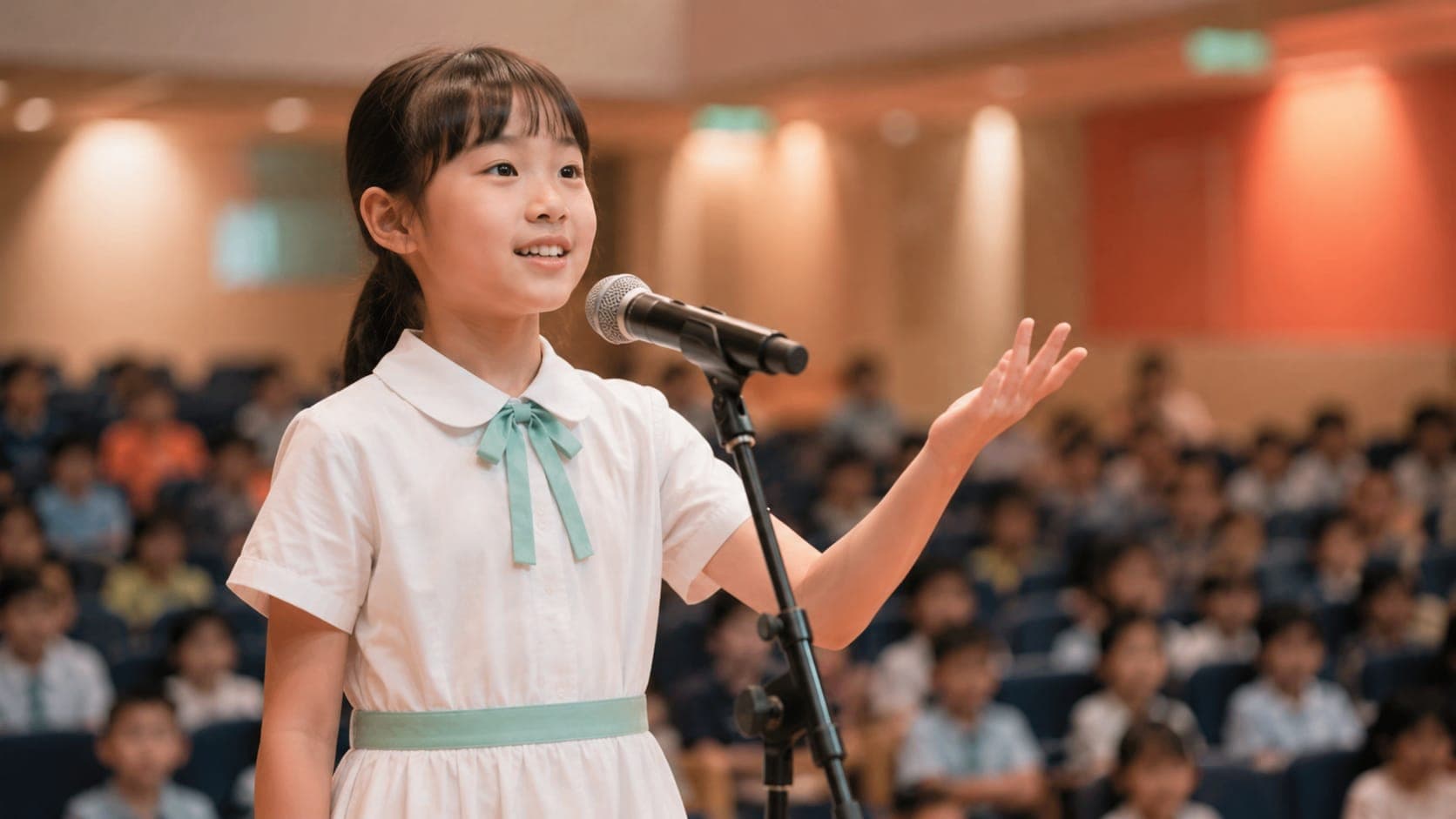
You have only three months — how should the time be divided?
Entries usually open in August, the set pieces are announced around September, and most heats fall between November and December. Once you allow for settling back into the new school year, there is realistically about two and a half months of steady practice. Without staged progress, the usual outcome is the same: weeks spent simply reading the text aloud, a late realisation that the delivery has no light and shade, and nerves on the day.
- 1
August · Entry
Decide on the language and class, and assess your child's level
- 2
September · Understanding and diction
Break the piece down once it is announced and establish accurate pronunciation
- 3
October · Delivery and stage presence
Intonation, pauses and stress, then add expression and gesture
- 4
November–December · Performance
Full run-throughs of the piece and work on composure
First time entering — Mandarin, Cantonese or English?
We suggest the language your child knows best or enjoys most. First-time nerves are very real, and competing in the language they are most confident in leaves them enough headroom to enjoy the recitation itself rather than fixating on remembering the words. Once they have a taste of success and some confidence, that is the time to branch out into other languages and feel how each one is delivered differently.
| Language | Common classes | Main challenge | Who should try it first |
|---|---|---|---|
| Mandarin | Solo poetry recitation, solo prose, choral speaking | Tone accuracy and emotional range | Children taught Chinese in Mandarin at school, or who speak Mandarin at home |
| Cantonese | Solo poetry recitation, solo prose, choral speaking | Breaking out of everyday speech patterns and finding a recitation voice | Native Cantonese speakers who need to develop a "stage voice" |
| English | Solo Verse Speaking, Prose, Choral Speaking | Stress, linking and rhythm | Children with a strong feel for English and a solid pronunciation base |
As for entering several pieces at once — if there is plenty of preparation time, the extra experience does no harm. But when practice time is short and the pieces are many, children often end up giving none of them proper attention. For a first entry, concentrating on a single piece usually produces noticeably better results.
How do you tell whether a piece suits your child?
For most classes at the Speech Festival the set piece is prescribed, so the real choice is which class to enter. What genuinely needs judging is this: can your child, at this stage, carry the emotional weight and sentence complexity of this particular piece?
- Length: younger children faced with a long piece tend to focus on remembering it and lose all expression
- Emotional distance: if the experience described is far removed from the child's own, the delivery stays on the surface
- Sentence structure: pieces full of long or inverted sentences demand more mature breath control
- Genuine interest: a piece a child responds to makes an enormous difference to their willingness to practise

What can parents do at home?
The most effective support is remarkably simple: make sure your child listens to the tutor's recording, and keep daily practice going. Beyond that, create as many performance occasions as you can — family gatherings, school events, even the park — so your child gets used to speaking up in front of others. A love of performing and genuine confidence are usually built in exactly these informal settings.
What works
- Play the tutor's model pronunciation recording daily for your child to imitate
- Short, regular practice — quality over quantity
- Create chances to speak in front of others and build up stage experience
- On the day, talk only about enjoying it; add no pressure
What tends to backfire
- Making the child memorise the piece before lessons even start
- Long single sessions, after which a tired child simply goes through the motions
- Practising only at home, then freezing in front of an audience
- Stressing placings, so the child treats the festival as an exam
Should the piece be memorised before lessons begin?
We advise against memorising too early. The right order is this: after the first lesson your child receives the tutor's full recording with model pronunciation, then imitates it, understands it and revisits it daily — memorisation happens naturally along the way. Brute-force memorising first tends to lock in the wrong intonation as well, and undoing that takes far more effort. It is the single issue we spend most time correcting in the classroom.
Further reading & courses
Key takeaways
- The effective window is about three months: entry in August, training in September, intensive drilling in October, heats in November–December
- A complete teaching cycle for one piece is 12 lessons, with 8 the recommended minimum
- For a first entry, choose the most familiar language and build a sense of success before branching out
- The most effective parental support is daily listening to the recording plus short, regular practice
- Do not memorise the piece before lessons start — wrong intonation, once set, is harder to correct
Frequently Asked Questions
- Q1What are the advantages of one-to-one private tuition for recitation?
- One-to-one tuition focuses squarely on a student's individual strengths and weaknesses, targets their delivery technique directly and attends to fine detail, which reaches the teaching goal considerably faster.
- Q2How many lessons give the best results?
- A complete teaching cycle for one piece is normally 12 lessons. We recommend booking at least 8.
- Q3For a first competition, can my child enter several pieces at once?
- If there is plenty of preparation time, the extra experience does no harm. But if practice time is short, the pieces are many and the child has little experience, they will not be able to concentrate properly on any of them. For a first entry we recommend a single piece.
- Q4Does my child need to wear school uniform?
- The Hong Kong Schools Speech Festival normally requires students to compete in school uniform. For other recitation competitions, unless stated otherwise, neat and presentable clothing with tidy grooming is sufficient.
- Q5Should gestures be added to a recitation?
- Eye contact and movement are taught as appropriate, depending on what the piece calls for and the child's year group; generally, the higher the year, the fewer the gestures. The number of gestures and what is expected also varies with the competition's own requirements.
- Q6Is there any extra reward for winning?
- Any student who has booked a full 8 lessons with us and places in the top three at a competition can receive a supermarket voucher as encouragement, on presenting the adjudication sheet and a photograph as a record: $200 for first place, $100 for second and $50 for third.
Sources
Online language education in Hong Kong · 17 years of teaching
Written by the Jinghua Language academic team. Founded in 2009, our centre specialises in live one-to-one online language tuition for students aged 3 to 18, covering Mandarin Chinese, English, Spanish, public examination preparation and recitation training, with 38 teaching and coaching awards to date.
Meet the academic team and editorial standards →About Us →Awards & Honours →
Published 2026-07-10 · Updated 2026-07-19