
Explore Chinese Food Culture over a Family Meal: 5 Conversation Topics
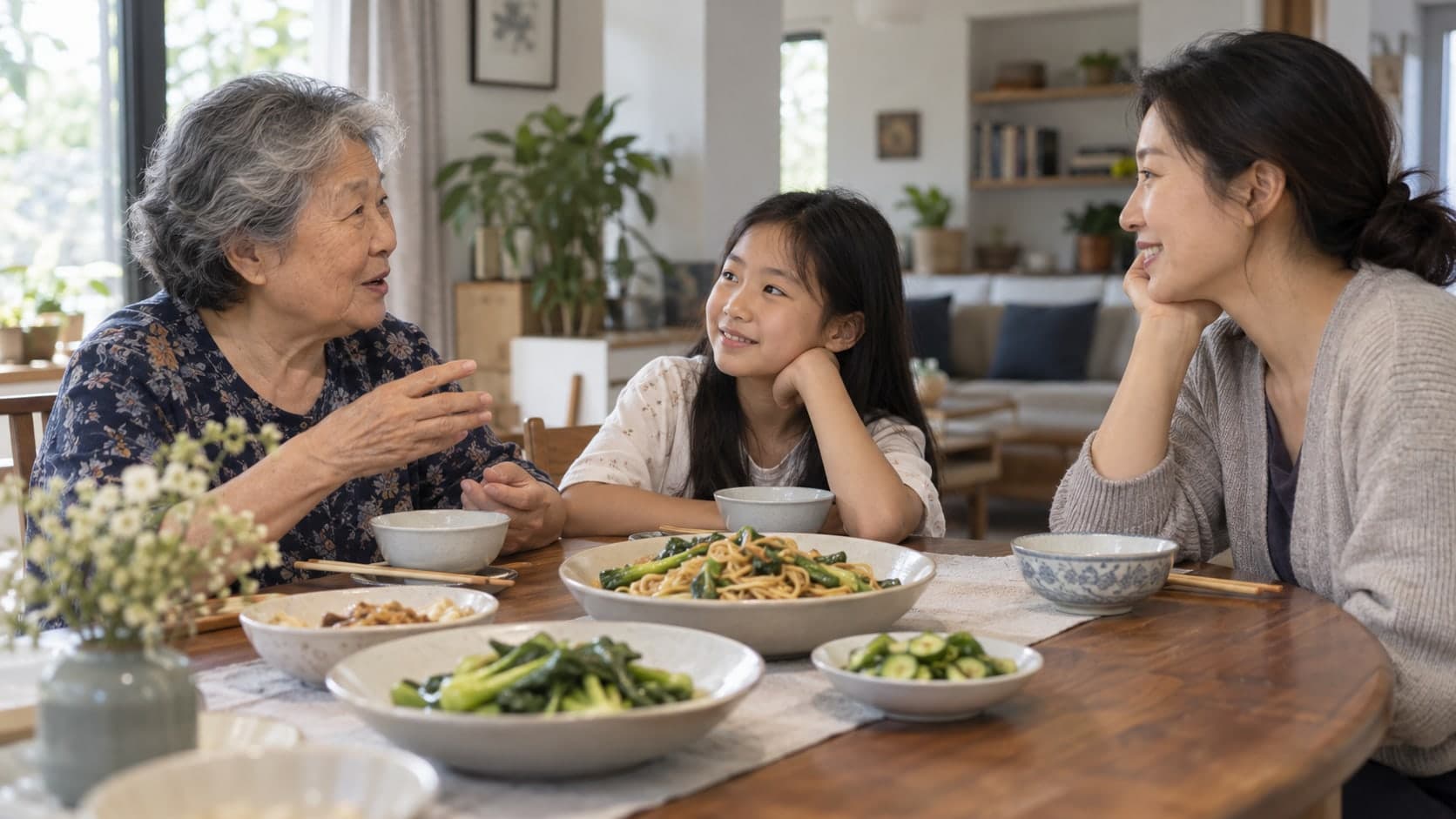
What cultural stories can begin with a bowl of noodles?
Your child asks at dinner, ‘Why do we put this in our noodles?’ You do not need a long history lesson. Explain who likes that ingredient, who taught the family the recipe, or how it changed after moving somewhere with different ingredients. Your child hears a family story and has a reason to describe a flavour or method in Mandarin. Finish chewing and swallowing before continuing the conversation.
Chinese food culture is not one fixed menu. Regions, communities, religions, migration and family habits all shape a meal. Say ‘Our family usually makes it this way’ rather than ‘Everyone eats it like this’. If you do not know a dish's history, ask relatives together instead of supplying an unverified origin story.
Which five topics connect food on the table with a child's own story?
| Family topic | One question to ask | What a child could express |
|---|---|---|
| 1 | Flavour and texture | ‘What does this smell like? Is it soft, crisp or smooth?’ | Point, draw or describe it in a familiar language, then try one Mandarin word; tasting is optional. |
| 2 | Our family's method | ‘What do we usually add to our noodles? What is different today?’ | Observe ingredients, describe an order or use ‘first… then…’ for steps they have seen. |
| 3 | Who passed on the recipe | ‘Who taught you this? Was it made the same way before?’ | Ask a relative one question, then share ‘Grandma said…’. Leave unknown details for another conversation. |
| 4 | Other families and places | ‘Does your friend's family eat this too? What do they add?’ | Name one similarity and one difference, without ranking authenticity. |
| 5 | Introducing it to a friend | ‘How would you introduce this to someone seeing it for the first time?’ | Share a name, flavour or family memory, then invite the friend's own version. |
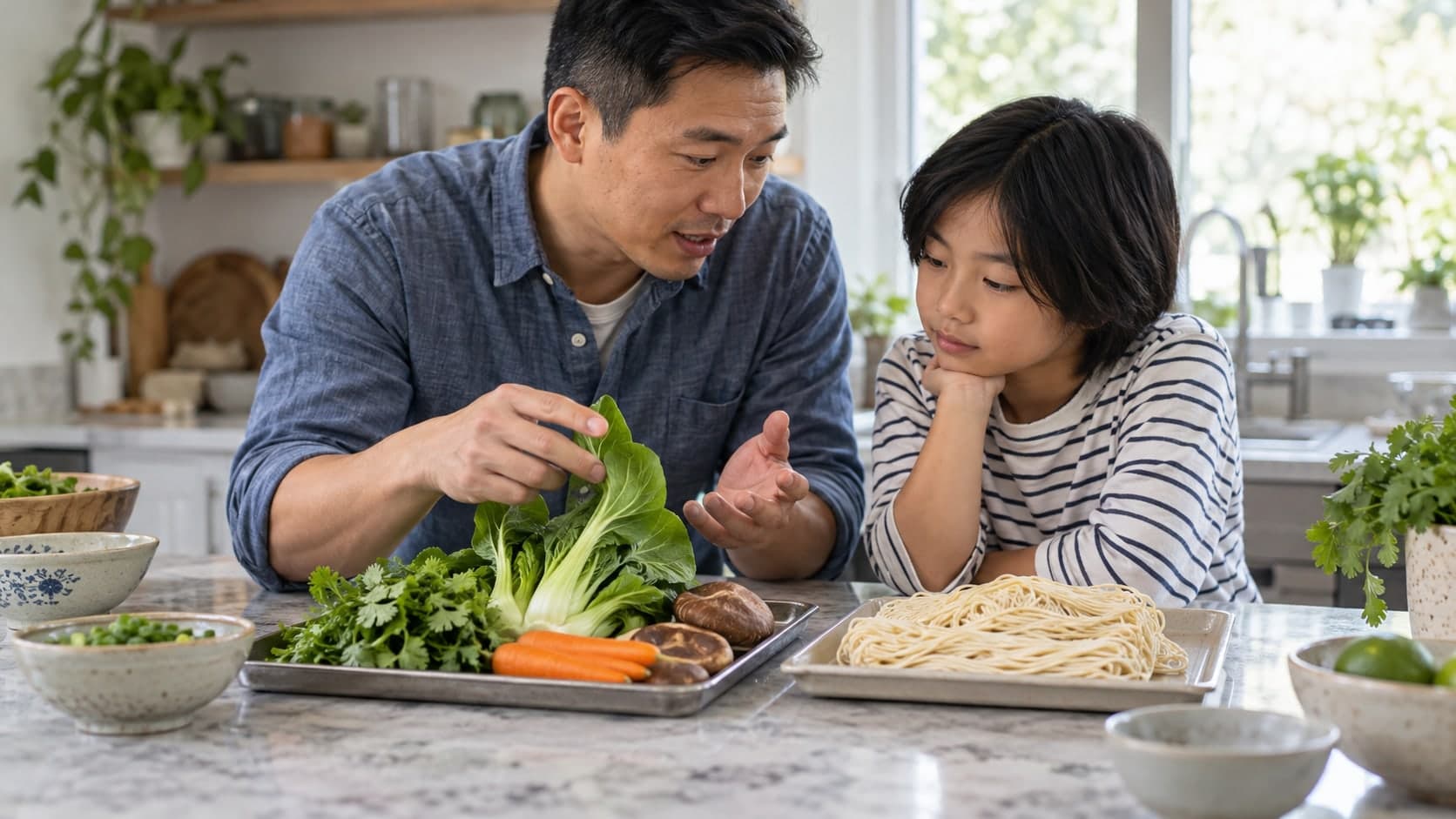
A younger child could point to an ingredient, draw a bowl or name one texture. An older child might interview relatives, photograph ingredients or prepare a short introduction for a friend. If you are not confident in Mandarin, tell the family story in the language you communicate best in, then choose one or two Mandarin expressions together. Every meal need not become translation practice.
How can a mealtime conversation stay enjoyable rather than become a test?
Helpful ways to explore
- Begin with one familiar dish the child is willing to observe.
- Describe your family's version and stay curious about others.
- Accept pictures, drawing, smelling when safe or listening to a story.
- Let the child ask questions and choose what interests them.
Unnecessary pressure
- Memorise every food name, festival meaning and historical date at once.
- Present one regional or family method as the only authentic version.
- Require eating unfamiliar, unwanted or unsuitable food.
- Ask for answers while chewing or turn every Mandarin word into a quiz.

How can you try a four-step activity today?
- 1
1 | Choose a familiar dish
Use something your family already prepares that meets dietary needs. A family photograph works if suitable food is not available.
- 2
2 | Look, smell, taste or observe preparation
An adult checks ingredients, temperature, texture and tools. Choose a way to participate that the child wants; tasting is not required.
- 3
3 | Ask about one family story
Ask who taught the recipe, why an ingredient is a favourite or what changed after a move. Note unknown details to ask relatives later.
- 4
4 | Share in your own words
After swallowing, describe a flavour, method or memory. Drawing or sharing with a relative is also possible; listen to their version too.
Which safety and cultural boundaries should adults check first?
| Consideration | The adult's responsibility | How a child can participate |
|---|---|---|
| Allergies, dietary needs and hygiene | Check ingredients, known allergens and cross-contact risks. Wash hands and clean surfaces. Follow existing professional advice for individual needs. | Use photographs, drawing or a family interview instead of requiring a new food. |
| Blades, heat and burns | Adults handle knives, hot pans, hot water and cooking appliances, keeping hazards out of children's reach. | Observe ingredients from a safe place or describe a cooled dish suitable for observation. |
| Choking and eating safely | Adapt food size and texture to the child, ensure stable seating and supervise. No talking, playing or walking with food in the mouth. | Chew and swallow before speaking. Looking without eating is fine when food is unsuitable. |
| Different cultural versions | Respect religions, places, food choices and ingredients used after migration; do not invent a single origin. | Say ‘Our family does it this way’ and ask ‘What about yours?’ |
Notice whether your child wants to describe a flavour or appearance, explain one family method, ask a relative a question or share with a friend. These are clues for choosing another topic, not scores for culture or Mandarin ability. Jinghua's live online Mandarin and Chinese learning can connect stories, pictures, conversation and level-appropriate reading and writing to life. It does not provide dietary therapy or promise nutritional benefits.
Connect family stories with Mandarin and cultural exchange
Key points: culture can begin with ‘How does our family eat this?’
- One familiar dish can open up flavours, methods, relatives' stories and different versions.
- Children can look, draw, listen or ask, without tasting or memorising definitions.
- Adults manage allergies, tools, temperatures, hygiene and safe eating; swallow before talking.
- Let children introduce food in their own words and respect other families' traditions.
Key takeaways
- Start with a familiar meal rather than a long history lesson.
- Family stories and different recipes create genuine reasons to use Mandarin.
- Safety and willingness come first; sharing matters more than a standard answer.
Frequently Asked Questions
- Q1Can a selective eater participate?
- Yes. Looking at ingredient photographs, drawing a table or asking a relative a question all count. Do not use Mandarin or culture as a reason to require unwanted food, or describe selective eating as disrespect. Consult an appropriately qualified professional separately if you are concerned about eating or health.
- Q2What if we cannot find the same ingredients overseas?
- Discuss how the family adapts local ingredients or compare versions through photographs. Substitutions are part of family life; an exact copy is not necessary. An adult must still check ingredients, allergies and dietary needs rather than assuming a similar-looking food is suitable.
- Q3How can I discuss food culture if my Mandarin is limited?
- Tell the story in the language your family communicates clearly in. Then choose one flavour or preparation word together and listen to a reliable model or ask the teacher. You need not translate a whole conversation while cooking or pretend to know every food's Mandarin name.
- Q4Must we make festival food or explain a dish's origin?
- No. Everyday noodles, vegetables or soup can start a conversation. Verify an origin before sharing it and acknowledge different versions. If uncertain, say ‘This is how our family remembers it’. Family memory and verifiable history are not the same thing.
- Q5How can siblings of different ages join in?
- Share one dish but offer different roles. A younger child can look at pictures or use a describing word; an older child can interview relatives, compare recipes or introduce the dish to a friend. Do not expect equal sentence length. Adults still supervise food, tools and materials according to individual needs.
- Q6How do we keep this from becoming a Mandarin test?
- Choose one real question, respond to the idea first, then naturally offer a Mandarin expression. If everyone is eating or the child does not want to talk, return later. Notice willingness to share and ask questions without counting errors or requiring a set number of new words.
Online language education in Hong Kong · 17 years of teaching
Written by the Jinghua Language academic team. Founded in 2009, our centre specialises in live one-to-one online language tuition for students aged 3 to 18, covering Mandarin Chinese, English, Spanish, public examination preparation and recitation training, with 38 teaching and coaching awards to date.
Meet the academic team and editorial standards →About Us →Awards & Honours →
Published 2026-10-18 · Updated 2026-10-18