
How Can Picture Books, Animation and Stories Help Children Discover Chinese Culture? 5 Family Ideas

Chinese culture feels distant to my child. How can a story make it closer?
Bring culture back to things a child recognises: a meal, festival, craft, object, a character’s choice or an intriguing moment in a story. A story is not a disguised knowledge test. It is a way for a child to notice, ask, express an idea and hear another person’s experience. Parents do not need to explain an entire tradition at once. Choosing one small section and leaving room for conversation and imagination often makes a child more willing to return.
Five ways to bring picture books, animation and stories into family life
| Family idea | What you can do | What to notice in the child’s response | A small next activity |
|---|---|---|---|
| Begin with one curious question | At the cover or opening scene, ask ‘What do you think this person wants to do?’ or ‘What might this object be for?’ | The child is willing to guess, point out a detail or name something they want to know. | Save the question in a drawing, sticker or spoken reminder and revisit it after the story. |
| Pause at one plot moment | You do not need to finish the whole book. Pause when a character makes a choice, faces a problem or finds a special object. | The child can name a feeling, reason or another possible choice. | Arrange three wordless pictures as beginning, turn and ending. |
| Let the child retell it in their own way | Accept a short sentence, movement, drawing or mixed language first, then invite one more detail. | Someone who has not seen the story can broadly understand the child’s main point. | Tell one part to a family member, friend or willing relative. |
| Make one small thing connected to the story | Cut out a character, draw a scene, make a greeting card or talk at dinner about a food in the story. | The child links the craft, food or everyday object back to the plot. | Photograph the creation and invite the child to introduce one choice. |
| Connect different family experiences | Ask whether your family has a similar story, habit or memory, while making room for ‘no’ as an answer too. | The child compares ideas, respects different ways of doing things or asks another cultural question. | Invite an older relative to share one version and look for similarities and differences together. |

What is the difference between turning a story into conversation and testing what a child remembers?
Reading like a knowledge test
- Rushing to ask for names, dates or answers and ending when the child replies.
- Allowing only one interpretation, so culture becomes information to memorise.
- Letting the parent speak most of the time, with no space for the child’s curiosity or family memories.
Reading as shared exploration
- Beginning with an image, feeling or surprising detail the child noticed.
- Allowing guesses, disagreement and links to the child’s own life.
- Using one small activity or share so the story still has a purpose after the page is closed.
A four-step family routine: take one story moment into a personal share
- 1
1 | Choose an age-appropriate moment
Pick a story, animation or picture-book page with clear images, a short length and something the child wants to approach.
- 2
2 | Pause where there is a feeling
Ask what the child sees, what the character may be thinking or which object feels most interesting.
- 3
3 | Make a response in one comfortable form
The child may say one sentence, draw, arrange three pictures or make a small craft. Let them choose the easier way in.
- 4
4 | Tell one other person
Invite the child to share one point with family, a friend or relative, and save the listener’s question as an opening for next time.
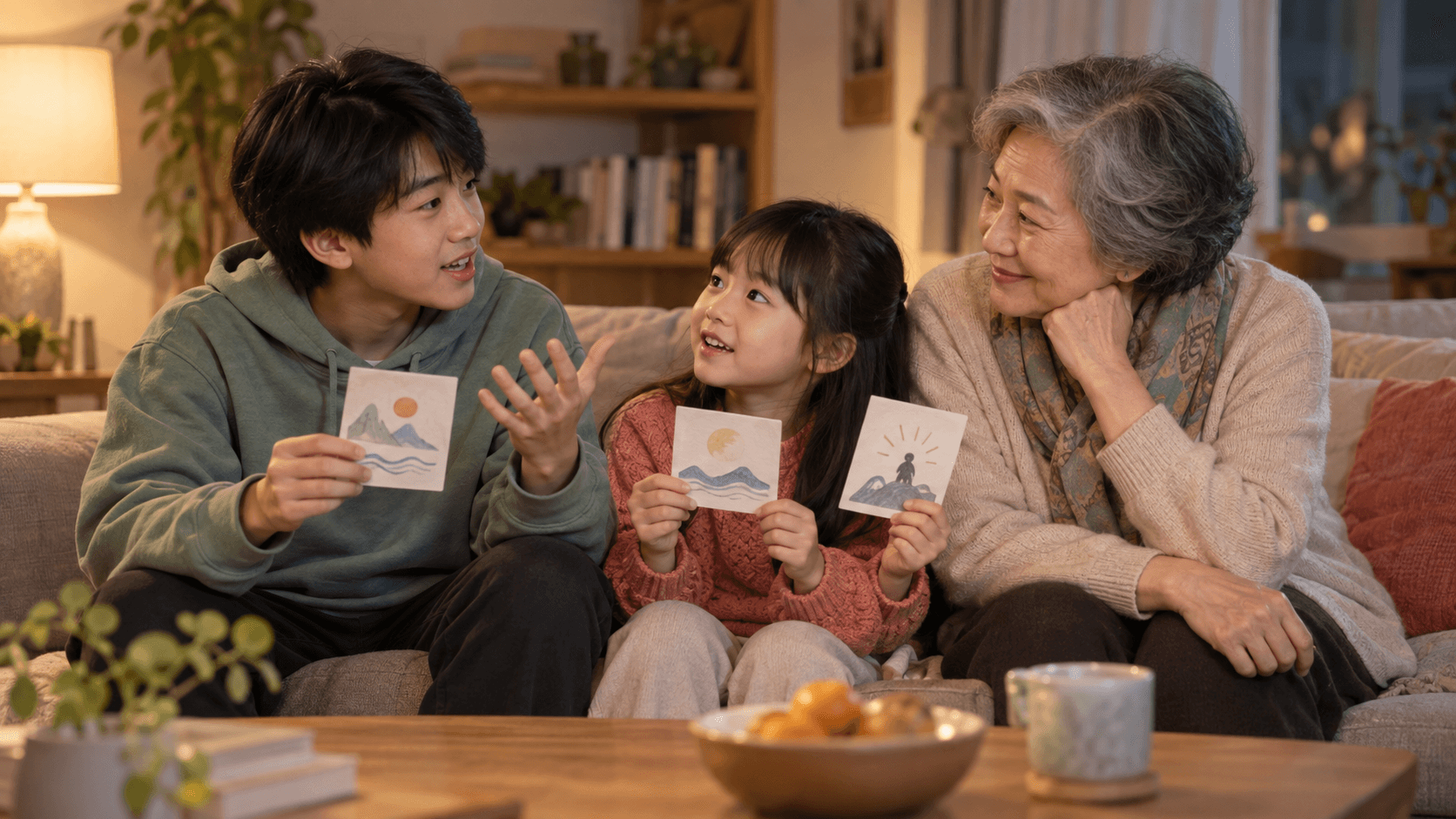
How should families choose material from ages 3 to 18? Start with interest and a comfortable way to understand
Ages 3–6 can begin with repeated lines, pictures, movement and character voices. Ages 7–12 can add questions such as ‘What would you do?’ or ‘Do we have anything similar at home?’ Ages 13–18 can choose mythology, folk stories, food, design, film, family memory or the everyday lives of Chinese communities in different places, and discuss viewpoints rather than memorise conclusions. When a story involves a particular place, belief or historical setting, check the source and explain that it is one of many cultural experiences, not a standard every family must accept.
Extend story reading into language and cultural exchange
Key points: cultural stories need room for curiosity, response and sharing
- Start with a character, object or moment that makes the child curious rather than a complete list of facts.
- Conversation, crafts and retelling can connect a story naturally with listening, speaking, reading, writing and family memory.
- Different ages and families can use different materials; cultural experience does not have only one version.
- The next step after a story is helping the child share one discovery clearly with another person.
Key takeaways
- Chinese culture can begin with stories, objects, food and family memory; it does not require a child to memorise knowledge first.
- Listen for what a child notices or wonders about, then use one question to carry the conversation on.
- Retelling, crafts and sharing help a story become the child’s own expression rather than passive viewing.
Frequently Asked Questions
- Q1Can we explore Chinese culture through stories if I do not know much about it myself?
- Yes. You do not need every answer in advance. Ask questions with your child, check one reliable source or invite a family member to share an experience. Be honest about what you do not know, do not turn a guess into a fact and leave room for the child to feel differently.
- Q2Does watching animation count as discovering culture?
- Animation can be a useful entry point because it gives children characters, setting and rhythm. Add one interaction afterwards: choose a memorable image, guess what a character might do next or tell the moment to someone else. Playing a video alone does not always become understanding or expression.
- Q3Does my child have to finish a classic story for it to be worthwhile?
- No. For many children, one clear and engaging section is more memorable than finishing a long text under pressure. Choose an adapted picture book, short animation or single plot moment, then follow the child’s interest. Completing a long work does not have to be the goal.
- Q4How should we discuss values in a story?
- Ask how the child understands a character’s choice and whether they would make a different choice today. You can share your own view without presenting it as the only correct answer. That lets children build understanding and respect different experiences.
- Q5What if my child wants to use English or another language to discuss the story?
- Accept the language that lets the child share an idea first, then offer one Chinese word or short phrase that matches the idea if it is useful. The aim is to keep the story connected with communication, not to block expression because every word is not in one language.
- Q6How can I tell whether this kind of activity suits my child?
- Notice whether the child returns to the story, asks a new question, retells one part, links it to a craft or family experience, or wants to share it with someone. These are observation clues rather than a score. Change the material or format if curiosity does not appear.
Online language education in Hong Kong · 17 years of teaching
Written by the Jinghua Language academic team. Founded in 2009, our centre specialises in live one-to-one online language tuition for students aged 3 to 18, covering Mandarin Chinese, English, Spanish, public examination preparation and recitation training, with 38 teaching and coaching awards to date.
Meet the academic team and editorial standards →About Us →Awards & Honours →
Published 2026-10-02 · Updated 2026-10-02