
From Repeating Mandarin to Real Conversation: 4 Everyday Ways to Help

What can you try when repetition is easy but a real question brings silence?
You say, ‘I like this puppy’, and your child repeats it. But ask ‘Which one do you like? Why?’ and they look at you, or answer in English or Cantonese. This does not necessarily mean they have learned nothing. In repetition, someone has already supplied the sounds and sentence. In conversation, your child also needs to understand, choose words and organise their own meaning. Make the question smaller and worth answering, rather than simply requesting another repetition.
Repetition can still provide a spoken model, but it need not be the end of every exchange. Tiredness, a broad question, an unfamiliar listener or little interest in the topic may all reduce a response. Look at the situation before labelling silence as shyness, language confusion or limited ability.
Which four everyday approaches give the next turn back to your child?
| Approach and setting | What a parent could say | A possible response | A useful next prompt |
|---|---|---|---|
| 1 | Replace repetition with two choices: before a meal | Instead of ‘Repeat blue bowl’, ask in Mandarin, ‘Would you like the blue bowl or the yellow bowl?’ | Points to the blue bowl, or says ‘blue’. | Acknowledge it: ‘You would like the blue bowl.’ Hand it over; a complete repetition is not required. |
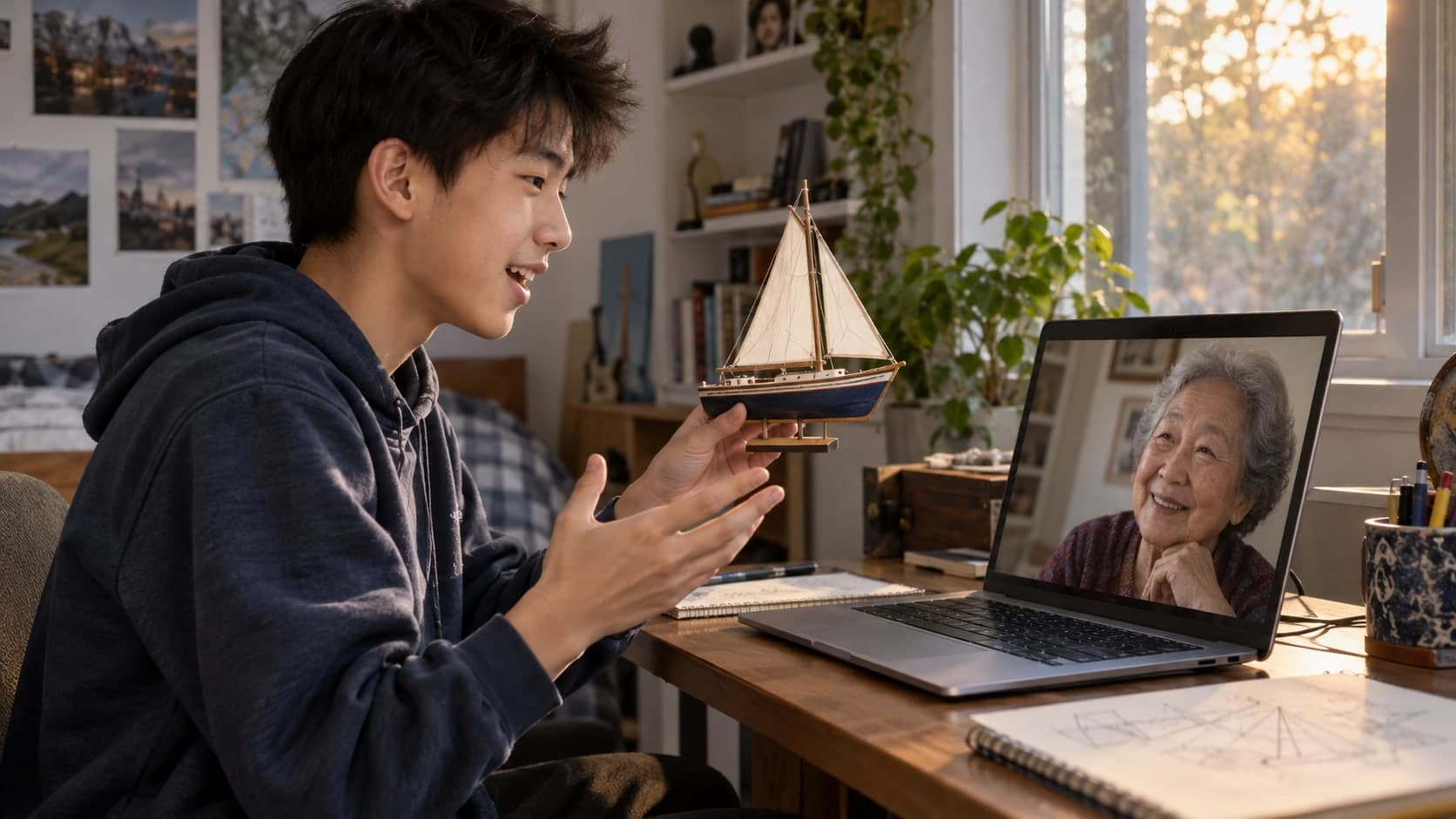
| 2 | Allow a response: a toy or hobby | Ask ‘Which model would you like to show me?’ Then pause and remain attentive instead of adding questions. | Thinks, picks up a model or says ‘this one’. | Wait for readiness. If needed, offer one small prompt, such as ‘What is this?’ Do not supply every answer. |
| 3 | Ask about one detail they know: a family video call | After ‘I made a boat’, ask ‘Which part of the boat do you like best?’ | Points to the sail, says ‘here’, or adds its colour. | Respond to the meaning: ‘So you like this sail.’ Follow one natural detail, rather than turning the call into a quiz. |
| 4 | Try a new person or setting: before going out | After practising a request at home, invite your child to tell a familiar relative ‘I want to bring…’, choosing their own item. | Says ‘I want to bring water’, or points to the bottle first. | Notice whether they can express the need to someone else. Offer a word if necessary and let them finish their meaning. |

A younger child might point, pick something up or say one word. An older child could discuss games, music, a trip or something they have made; the wording should not sound like a preschool activity. Adjust the same approach without expecting equal sentence length at every age. Acknowledge the meaning first, then model one expression the child can use.
Are you practising repetition or supporting your child's own expression?
Gradually returning the turn
- Ask about a genuine choice or an experience the child knows.
- Ask one question, noticing gaze, gestures and words.
- Respond to the meaning before naturally modelling Mandarin.
- Try a different object, listener or setting.
Only requesting repetition
- Supply every complete answer and check whether it is copied.
- Add questions or answer for the child as soon as they pause.
- Interrupt every sound so the topic never develops.
- Practise familiar sentences and assume they can already be used elsewhere.
How can you try this today? Four steps around something familiar
- 1
1 | Choose something familiar
Choose a bowl, a toy or a creation to show a relative. Make sure the child has a real preference or experience to share.
- 2
2 | Ask a small question and wait
Offer two choices or one easy-to-understand question. Pause and notice the response without a fixed waiting time or pressure.
- 3
3 | Accept the meaning, then one detail
Accept a gesture, one word or another language, and model a useful Mandarin phrase. Ask about one detail only if the child is willing.
- 4
4 | Try another setting and reflect
Use another natural opportunity or familiar listener. Note what the child supplied independently and which prompt helped.
What small changes matter besides sentence length?
| Observable sign | A concrete example | A conclusion not to rush into |
|---|---|---|
| Moving from choosing to a short answer | From pointing at a bowl to saying ‘the blue one’, then naming a preference. | One successful answer does not mean every question is understood. |
| Adding a detail independently | After ‘I made a boat’, adds ‘This sail is red’ without being asked. | No extra detail today may reflect the topic or mood. |
| Asking or answering a follow-up | Asks ‘Do you like it?’ or answers a relative's natural question. | Do not score question counts or use silence as a diagnosis. |
| Trying the language elsewhere | Uses a familiar expression in a family call or while preparing to go out. | Prompts may still be needed; a new setting need not be equally fluent at once. |
To explore how your child listens, responds and expresses ideas with a real person, discuss Jinghua's live online one-to-one Mandarin options. A trial can help identify a starting point and suitable prompts, linking listening, speaking, stories and level-appropriate reading and writing to life. One trial cannot establish future learning speed or results.
Bring Mandarin back to everyday communication
Key points: offer a model and room for your child's next sentence
- Repetition supplies a spoken model; it is not independent conversation.
- Choices, waiting, one detail and a new setting create room for original words.
- Respond to meaning and offer a helpful prompt rather than correcting every sound immediately.
- Look across everyday responses without promising a fixed number of days, lessons or outcomes.
Key takeaways
- A question with a real purpose gives a child something of their own to say.
- Gestures, one word or a familiar language can start a conversation.
- Notice added details, follow-ups and use in new settings, not only accurate repetition.
Frequently Asked Questions
- Q1What if my child answers in English or Cantonese?
- Show that you understood, then reply naturally in Mandarin. If your child says ‘blue’, you could say ‘You would like the blue bowl’ in Mandarin. Invite one word if they are willing, without requiring every sentence again. One use of different languages does not establish confusion or ability.
- Q2Should I correct Mandarin pronunciation immediately?
- In everyday conversation, first consider whether you understand each other. Model the pronunciation naturally in your reply. If a sound repeatedly affects understanding, discuss separate practice with the teacher. Interrupting every sentence can stop the topic, but providing no model is not the only alternative.
- Q3What if my child gives no response at all?
- Reduce the questions and consider tiredness, understanding and interest. Try an object, pointing or two choices, or stop and return at a natural moment. Do not force speech. If you remain concerned about understanding or communication across languages and everyday settings, consult an appropriately qualified professional rather than using this article to diagnose.
- Q4Is repetition still useful?
- Some repetition can help a child hear a sound or become familiar with a useful phrase. Follow it with a real choice or question. After modelling ‘I want to bring water’, let the child choose what to bring. Neither constant repetition nor removing every model is necessary.
- Q5Can these four approaches work for teenagers?
- The approaches can be adapted, but the topic and tone should respect their age. Discuss music, hobbies, travel plans or a creation of their own, and let them choose what to share. Offer keywords when needed, without preschool-style rewards or a whole dialogue to copy.
- Q6How do I decide whether to continue an activity or change it?
- Consider willingness, the usefulness of prompts and whether the child tries the language at another natural opportunity. If adults supply every answer, make the question smaller. If the child adds their own details, try another listener or topic. There is no universal timetable or lesson count.
Online language education in Hong Kong · 17 years of teaching
Written by the Jinghua Language academic team. Founded in 2009, our centre specialises in live one-to-one online language tuition for students aged 3 to 18, covering Mandarin Chinese, English, Spanish, public examination preparation and recitation training, with 38 teaching and coaching awards to date.
Meet the academic team and editorial standards →About Us →Awards & Honours →
Published 2026-10-18 · Updated 2026-10-18