
How can multilingual families help children want to speak Mandarin? Five everyday ideas

Why does my child understand Mandarin but always answer in English or Cantonese?
Multilingual children usually choose the language that works most easily in the moment. If Mandarin appears mainly during correction, questioning or formal practice, a child has little reason to use it voluntarily. Start with one low-pressure situation that has a person and a purpose: greeting a relative, choosing dinner, introducing a toy or discussing a cartoon scene. Make Mandarin useful first, then gradually extend the sentences and ideas.
Five everyday ideas that put Mandarin to real use at home
| Everyday idea | What a parent can do | What a child may say | What to notice |
|---|---|---|---|
| Make one daily choice | Use Mandarin to choose a snack, clothes, music or a weekend activity. | I want the apple. Let's hear this song. | Does pointing or one word gradually grow into a short phrase? |
| Start with a story or cartoon | Watch a short part and ask about a favourite character or funny moment. | I like this person because… | Does the child talk about content rather than only answer right or wrong? |
| Follow the child's interest | Turn dinosaurs, football, art, music or technology into a Mandarin topic. | I want to show you this one. | Does familiarity lead to more questions and details? |
| Let the child teach a phrase | Even without fluent Mandarin, ask the child to demonstrate one phrase and use it that day. | Not like that. Say it this way… | Does the child feel able to lead the conversation too? |
| Connect with a real person | Call a relative, introduce an interest to a new friend or use a Mandarin phrase during a cultural activity. | I recently learned… | Can the child continue for one or two turns after the other person responds? |
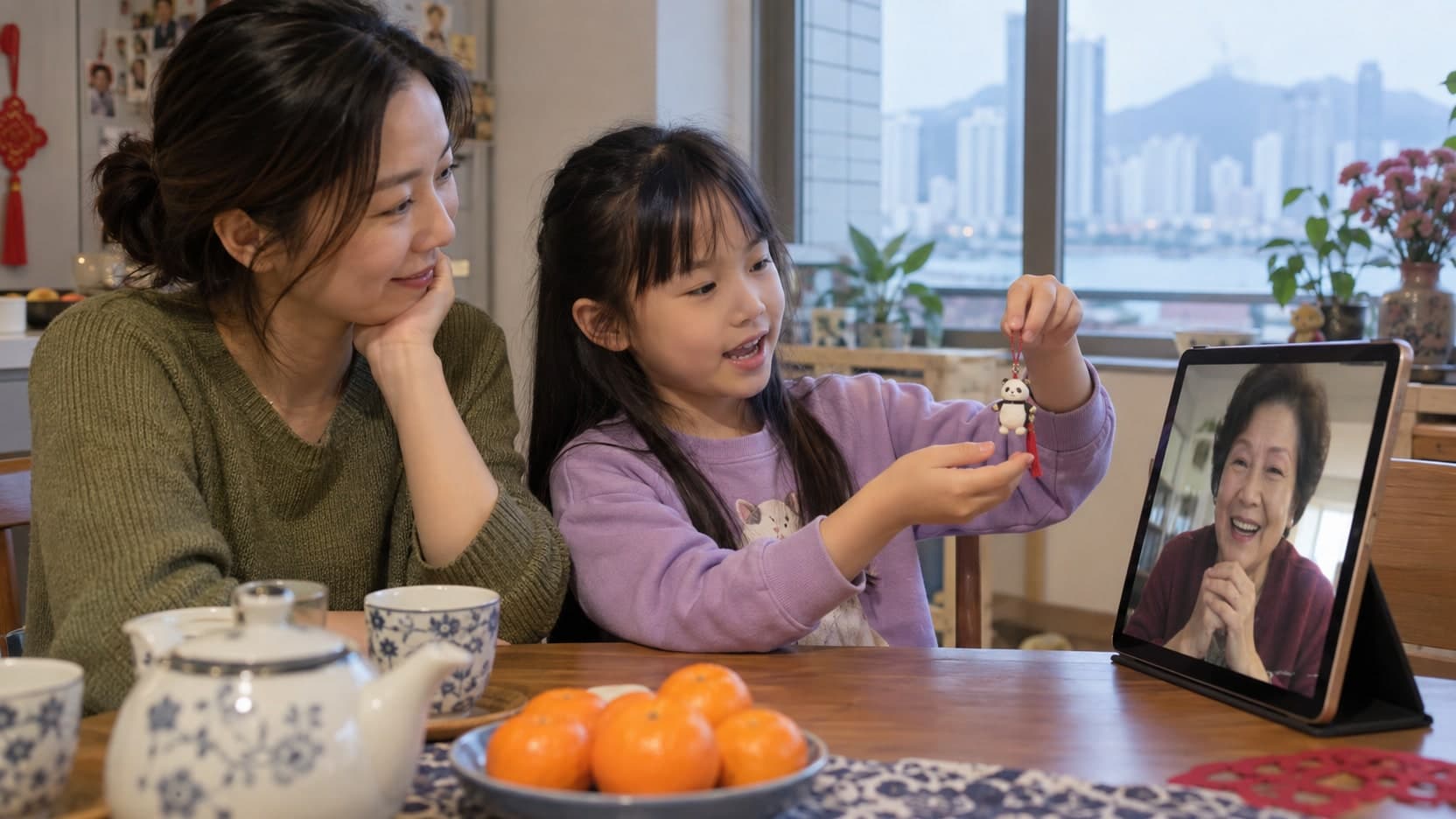
What is the difference between demanding ‘Mandarin only’ and helping a child use Mandarin?
Turning every conversation into correction
- The child must restart the whole sentence whenever English or Cantonese appears.
- Parents test vocabulary and meanings until an everyday topic feels like questioning.
- The family counts how much Mandarin was spoken but misses whether the child wanted to communicate.
Using Mandarin to do something
- Accept pointing, one word or mixed language, then model one natural Mandarin phrase.
- Discuss a story, person or activity the child already enjoys so content drives the language.
- Respond genuinely to the idea, then invite the child to say one step more.
A four-step family routine: build one sustainable Mandarin situation each week
- 1
1 | Choose one everyday situation
Pick eating, play, a call, reading or getting ready to go out—whichever the child joins most willingly.
- 2
2 | Prepare two or three phrases
Choose Mandarin the family will really use, model the meaning and do not demand perfect repetition.
- 3
3 | Let language complete a purpose
Use Mandarin to choose, joke, share a creation or respond to a relative so the exchange has a result.
- 4
4 | Notice whether the child uses it again
Look for quicker responses, voluntary details or willingness to speak with another person, then continue or adjust.

How should topics change from ages 3 to 18? Older children need genuine choice
Ages 3–6 can use actions, pictures, songs and repeated Mandarin phrases in play. Ages 7–12 can discuss cartoons, sport, food, festivals or family trips in Mandarin, then tell a relative one piece of news. Ages 13–18 need age-appropriate material: music, film, technology, popular culture, future study, migration or international exchange. Mandarin can connect children with relatives, the global Chinese-speaking community and Mainland markets; English and Spanish open other cultural and communication settings. Three languages do not require equal time. Plan around family life and the situations in which the child is likely to use them.
Connect Mandarin at home with immersive language learning
Key points: children need a reason to use Mandarin as a communication tool
- Speaking little Mandarin does not automatically mean a child lacks interest or ability.
- Begin with one low-pressure situation that has a real purpose, then increase Mandarin gradually.
- Stories, cartoons, interests and family relationships can connect Mandarin with both ideas and emotion.
- Topics should change with age; teenagers especially need choice and genuine conversation partners.
Key takeaways
- Children usually choose the language that completes communication most easily, so Mandarin must first become useful.
- Accept short answers and mixed language as a starting point, then model Mandarin naturally.
- Mandarin can connect family, culture and global Chinese-speaking communities, but the plan should fit each family's real life.
Frequently Asked Questions
- Q1Can we practise at home if the parent is not fluent in Mandarin?
- Yes. Listen to a short story or watch a short clip together, ask the child to teach one phrase and use it during the day. A parent creates interest and opportunities; they do not need to replace a professional teacher who works on pronunciation.
- Q2Should I make my child repeat an answer given in English or Cantonese?
- Respond to the meaning first, then recast part of it in Mandarin. If the child says ‘I want this’, reply with the natural Chinese phrase and act on the choice. Invite the child to repeat a key phrase when willing, rather than restart every sentence.
- Q3Is watching Mandarin cartoons enough?
- Cartoons provide sound, stories and interest, but viewing alone may not become active expression. Choose one scene and ask about a character, imitate one line or retell it to someone who did not watch it.
- Q4What if a teenager finds Chinese material childish?
- Let the teenager help choose music, film, sport, technology, food culture, travel or future exchange. Material can be short, but it should respect the learner's age and allow a personal viewpoint instead of predetermined answers.
- Q5How much Mandarin time should we plan each day?
- There is no universal number of minutes. Put Mandarin into one brief situation that already happens, keep it for several weeks, then notice quicker responses, voluntary details or willingness to use it with someone else before adjusting.
Online language education in Hong Kong · 17 years of teaching
Written by the Jinghua Language academic team. Founded in 2009, our centre specialises in live one-to-one online language tuition for students aged 3 to 18, covering Mandarin Chinese, English, Spanish, public examination preparation and recitation training, with 38 teaching and coaching awards to date.
Meet the academic team and editorial standards →About Us →Awards & Honours →
Published 2026-09-30 · Updated 2026-10-01