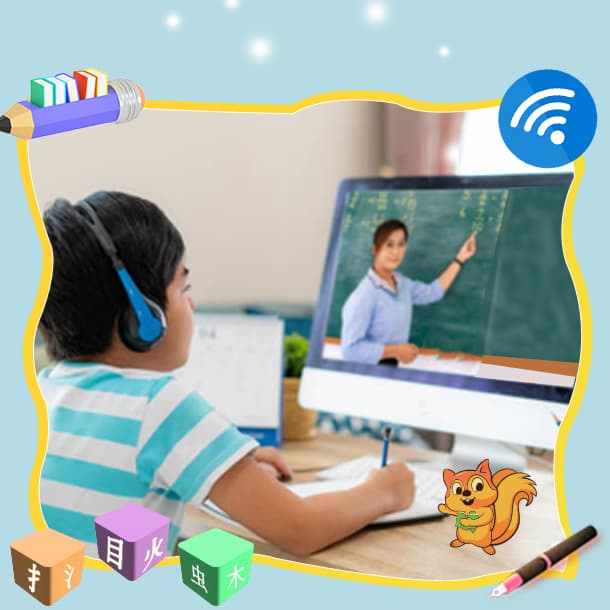
When choosing an online Mandarin class in Hong Kong, begin with a child's age, Cantonese-influenced pronunciation and school needs. A live one-to-one lesson can start with Pinyin, pronunciation, literacy or Chinese writing at the child's actual level, then set a manageable pace after a trial assessment.
9 courses
Chinese Mandarin
When choosing an online Mandarin class in Hong Kong, begin with a child's age, Cantonese-influenced pronunciation and school needs. A live one-to-one lesson can start with Pinyin, pronunciation, literacy or Chinese writing at the child's actual level, then set a manageable pace after a trial assessment.
Designed specifically for the kindergarten-to-primary transition, the course is built around sixty everyday themes (spanning general knowledge, art, science and history) through which children learn Hanyu Pinyin systematically via stories, nursery rhymes and interactive games. From initials, finals and tones to blending rules, it helps children build a solid, standard Mandarin pronunciation base — quietly building vocabulary while broadening their view of the world, and laying a gentle staircase towards independent reading and language study.
Course Highlights
· Thematic immersion: each level builds vocabulary and complete sentences around a different theme
· Pinyin made fun: songs, animation and interactive games make pronunciation stick
· All-round development: character recognition, picture description and simple expression spark a love of speaking
· Small graded classes: five levels from Preparatory to Advanced Plus, 24 lessons each, step by step
Course Levels
Preparatory – Elementary – Intermediate – Advanced – Advanced Plus: five levels in total, 24 lessons each.
Drawing on the most frequently used basic Chinese characters, the course guides children to recognise and master characters step by step, understanding and remembering them quickly and building reading confidence. Language points are woven into themed activities and role-play scenarios matched to each age group's cognitive stage, so that during the critical window for literacy and reading children grasp the fundamentals with ease, experience the joy and success of reading independently, and build a reading ability that serves them for life.
Course Highlights
· High-frequency literacy: master common characters, collect elegant words and phrases, and feel the emotion in a text
· Awakening language sense: through rhymes, poems and stories, learn to organise language and continue a story
· Word-class basics: use nouns, verbs, adjectives and reduplicated words to enrich expression
· Staged progression: five levels from Preparatory to Advanced Plus, 24 lessons each, steady improvement
Built around carefully selected texts and supported by Hanyu Pinyin, this is a long-term, immersive course pitched at native-speaker standard. Starting from a systematic study of Pinyin, students progress level by level through word formation, sentence building and reading comprehension, until they can finally read passages fluently without Pinyin and quickly grasp the main points of a text. Selected texts include Tang poetry, classical Chinese and other canonical works, so that students not only speak standard Mandarin but also develop a solid command of Chinese reading, writing, appreciation and expression. A solid command of Chinese reading, writing, appreciation and expression.
Course Content
· Close reading, learning through reading: selected mainland Chinese language texts are read and explained passage by passage, building vocabulary and a sense of text structure
· Pinyin as a tool for independent reading: systematic study of initials, finals, tones and blending rules takes students from "reading with Pinyin" to "recognising characters through Pinyin"
· Language fundamentals, consolidated level by level: word formation, sentence building, synonyms and antonyms, punctuation — a firm grounding in Chinese
· Advanced reading, from modern to classical: training in identifying the main idea and analysing sentence patterns; Tang poetry and classical Chinese deepen comprehension
· Speaking with confidence: class discussion, storytelling from pictures and themed presentations train expression and logical organisation
Course Levels
Six levels in total, each split into two volumes of 24 lessons.
The course concentrates on core language training — vocabulary, grammar, sentence reordering, sentence patterns, punctuation, recognising figures of speech and reading comprehension — to raise students' overall command of Chinese and their literacy skills. Writing techniques for every text type are taught systematically, with guidance on interpreting the question, planning and expressing ideas, and correction of common writing pitfalls. Closely aligned with the Hong Kong Education Bureau's Chinese Language curriculum, it nurtures a genuine interest in writing and lifts writing standards effectively.
Course Content
· Full text-type coverage: narrative, descriptive, expository and argumentative writing, practical writing and creative storytelling
· Visible thinking: mind maps are used to interpret the question and organise ideas, prompting planning and selection of material
· A bank of material: elegant vocabulary and model sentences enrich content and add polish to expression
· Self-editing: students develop the ability to revise their own work and form rigorous writing habits
Course Levels
Six levels in total, each split into two volumes of 24 lessons (reading and writing are graded in parallel)
Academically supported by the Institute of Chinese Language Education of Peking University, this course is designed for Hong Kong students seeking an authoritative Mandarin qualification. It follows the GAPSK syllabus closely and covers all four skills — listening, speaking, reading and writing. Systematic teaching combined with high-fidelity mock papers familiarises students with the public exam formats and exam technique, building confidence quickly and helping them secure a certificate that carries weight — solid evidence of language ability for future school applications and interviews.
Course Content
· Aligned with Peking University expertise: follows the latest official syllabus, with scientific, objective training across all four skills.
· High-fidelity exam practice: selected mock papers give realistic practice, familiarising students with the format and closing gaps
· Greater exam confidence: from technique to mindset, students answer more fluently and win awards with ease
· Precisely pitched lesson counts: finely graded by age and level, 16 lessons per level, working steadily through each grade
Course Levels
Separate kindergarten, lower primary, upper primary and junior secondary groups, 16 lessons per level, efficiently linked to a qualification recognised for school admissions.
Accreditation
Our centre is a GAPSK accredited course partner and member.
To encourage primary and secondary students whose first language is not Chinese to study the language, and to develop and raise their Chinese ability, Hanban (the Chinese National Office for Teaching Chinese as a Foreign Language) has, since 2004, brought together specialists in Chinese language teaching, linguistics, psychology and educational measurement from China and abroad. On the basis of extensive research into how Chinese is actually taught in schools overseas, they developed the new Youth Chinese Test (YCT).
Course Content
Candidates who pass YCT Level 1 can understand and use the most common Chinese words and sentences, and are equipped to study Chinese further.
Candidates who pass YCT Level 2 can understand and use some very simple Chinese words and sentences, meeting basic communication needs.
Candidates who pass YCT Level 3 can communicate simply and directly in Chinese on familiar everyday topics, reaching a strong elementary standard.
Candidates who pass YCT Level 4 can use Chinese to handle basic communication tasks in daily life and study, and can cope with most situations they encounter when travelling in China.
Course Levels
The YCT has a written and a spoken component, which are independent of each other. The written test comprises YCT Level 1, YCT Level 2, YCT Level 3 and YCT Level 4; the spoken test comprises YCT (Elementary) and YCT (Intermediate), and is conducted as a recording.
Designed for working professionals and job seekers across a range of industries — healthcare, law, finance, retail and tourism among them. The course is practical in orientation and tailored to each student's circumstances and workplace needs. Content progresses from the straightforward to the demanding, helping learners master Hanyu Pinyin and standard pronunciation in a short time, with a strong emphasis on high-frequency workplace conversation, so that a solid phonetic foundation translates into a professional impression in business discussions and job interviews.
Course Content
· Targeted to your career: business scenarios by industry, teaching both everyday and sector-specific terminology
· High-frequency conversation practice: focused on speaking, correcting learners' pronunciation and improving overall fluency
· Fast-track Pinyin and pronunciation: systematic teaching of basic phonetics and Pinyin so learners grasp the essentials quickly
· Three levels — Elementary, Intermediate and Advanced — rigorously structured to break through workplace language barriers step by step
Course Levels
Elementary – Intermediate – Advanced: three levels in total, 48 lessons each.
(On completion, learners may progress to the PSC Putonghua Proficiency Test preparation class run by the State Language Commission)
The Chinese Proficiency Test (Hanyu Shuiping Kaoshi, or HSK) is an international standardised test of Chinese proficiency for non-native speakers (including foreign nationals, overseas Chinese and members of China's ethnic minorities). It focuses on candidates' ability to use Chinese to communicate in daily life, study and work, its main purpose being to let candidates gauge their command of the language. As the world's most authoritative unified Chinese proficiency test, the HSK has become an important way for learners to measure their own level and demonstrate their Chinese ability to others.
Written Test
Candidates who pass HSK Level 1 can understand and use some very simple Chinese words and sentences, meet specific communication needs, and are equipped to study Chinese further.
Candidates who pass HSK Level 2 can communicate simply and directly in Chinese on familiar everyday topics, reaching a strong elementary standard.
Candidates who pass HSK Level 3 can use Chinese to handle basic communication tasks in daily life, study and work, and can cope with most situations they encounter when travelling in China.
Candidates who pass HSK Level 4 can discuss a fairly wide range of topics in Chinese and communicate with native speakers with reasonable fluency.
Candidates who pass HSK Level 5 can read Chinese newspapers and magazines, enjoy Chinese film and television, and deliver a reasonably complete speech in Chinese.
Candidates who pass HSK Level 6 can easily understand the Chinese they hear or read, and express their views fluently in Chinese, whether spoken or written.
Spoken Test
Candidates who pass the HSKK Elementary spoken test can understand and speak about reasonably familiar everyday topics in Chinese, meeting basic communication needs.
Candidates who pass the HSKK can understand and communicate with native Chinese speakers with reasonable fluency.
Candidates who pass the HSKK Advanced spoken test candidates can understand and express their views fluently in Chinese.
Course Levels
The HSK (written test) comprises HSK Level 1, HSK Level 2, HSK Level 3, HSK Level 4, HSK Level 5 and HSK Level 6.
The HSKK comprises the Elementary, Intermediate and Advanced spoken tests.
The State Language Commission's Putonghua Proficiency Test (PSC) is the single most authoritative official Mandarin examination system, recognised worldwide. This course is designed for candidates preparing for the PSC and is entirely oriented towards the oral examination. By breaking down the core tasks — reading words and passages aloud and speaking on a given topic — it provides comprehensive, systematic training and targets individual weaknesses, so that learners master exam preparation methods in full and secure this national-level qualification.
Course Content
· Aligned with official standards: follows the State Language Commission's assessment criteria, with precise correction of pronunciation and intonation
· Breakthroughs in the oral exam: focused on reading aloud and the set-topic talk, with techniques for the trickiest tasks and stronger spoken communication
· High-fidelity mock tests: a fully authentic exam environment lets learners practise in real conditions and shed exam-day nerves
· A golden preparation plan: six months of systematic study, one lesson a week, building efficiently towards the three grades and six bands
Course Levels
48 lessons in total (roughly a six-month preparation period), building steadily towards a national-level qualification.
Frequently Asked Questions
Jinghua's Mandarin programmes serve learners from K2 to secondary school. Younger children can begin with listening, Pinyin and everyday expression, while older learners can focus on reading, writing, Putonghua-medium study or examinations. A trial lesson is a better starting point than choosing only by year group.
Yes, when the tutor identifies the specific issue first, such as tones, retroflex sounds, final sounds or n/l. Lessons can then combine listening discrimination, mouth-position cues, contrast practice and immediate feedback instead of asking every child to repeat the same drill.
Children benefit from listening, tones and useful everyday phrases before formal Pinyin tables. Pinyin works best when it supports speaking and reading in context, rather than becoming a memorisation task detached from real language use.
Message us on WhatsApp and a dedicated academic advisor will assess your child's level and map out a learning path.
Jinghua Language delivers this course as live one-to-one online tuition, tailored to each student's level and goals.
Yes. Book a trial lesson so the tutor can understand the student's current level and recommend a suitable course plan.
Not sure which course fits your child?
Message us on WhatsApp and a dedicated academic advisor will assess your child's level and map out a learning path.